
Managing VIP Expectations in a Hybrid Environment
Managing VIP expectations in a hybrid environment requires more than polished stagecraft. For enterprise events, the real challenge is aligning executive, speaker, and stakeholder expectations with the actual capabilities and constraints of live streaming infrastructure, venue acoustics, network transport, production control, and platform interoperability. VIP attendees, whether seated in-room or joining remotely from boardrooms, hotels, or regional offices, expect broadcast-grade reliability, consistent audio intelligibility, low-latency interaction, and a presentation experience that feels intentionally designed rather than retrofitted. In a corporate hybrid setting, any mismatch between expectation and delivery becomes visible immediately, especially when leadership audiences compare the online experience against the physical event.
From a production engineering perspective, hybrid VIP management starts long before show day. It begins during technical discovery, when the event team defines the business-critical moments, identifies the stakeholders with the highest visibility, and translates those priorities into signal flow, encoding profiles, redundancy paths, camera plans, audio routing, and platform selection. A hybrid board meeting, an executive town hall, a global product launch, and a Singapore regional leadership summit each impose different tolerances for latency, interactivity, translation, recording, and archival requirements. The production system must be configured to serve both the in-room experience and the virtual audience without degrading either one.
Defining VIP Experience Requirements in Technical Terms
VIP expectations are easiest to manage when they are expressed in measurable production parameters. Executives rarely speak in terms of RTMP, SRT, or multiview layouts, but they understand continuity, clarity, and responsiveness. The production team must convert those qualitative expectations into technical service levels. That means defining target resolution, frame rate, latency budget, audio loudness targets, failover behavior, and support thresholds for interactivity and speaker confidence monitoring.
Translating stakeholder priorities into system requirements
For a high-visibility hybrid event, the production specification should establish whether the primary output is 1080p60, 1080p30, or 2160p UHD, and whether the downstream delivery environment can sustain that format across all endpoints. Many enterprise streaming environments still standardize on 1080p30 or 1080p60 because the combination of network stability, encoding efficiency, and conference platform compatibility remains favorable. If a session includes remote panelists or multilingual interpretation, the control architecture should also account for auxiliary feeds, return video, and isolated recording channels.
VIP audiences are particularly sensitive to lip-sync issues, compression artifacts, and audio dropouts. A practical enterprise standard is to maintain clean audio at consistent loudness, with disciplined gain staging through the console, limiter protection on the program bus, and dedicated monitoring at front-of-house and control positions. Audio quality often determines whether a VIP perceives the event as premium. A 300 ms video delay can be acceptable in a controlled corporate stream if audio remains stable and the show caller has proper confidence monitoring. In contrast, fluctuating audio, echo from poorly managed remote returns, or audible network jitter can undermine the entire executive experience.
Expectation mapping for in-room and remote VIPs
In-room VIPs expect a tightly managed show environment with clear sightlines, direct confidence monitors, proper lighting ratios, and minimal technical distraction. Remote VIPs expect a seamless viewing surface, accurate framing, and a low-friction path into the event platform. For hybrid productions, the most effective model is to treat remote executives as first-class attendees, not secondary viewers. That includes testing their access paths, validating corporate firewall compatibility, confirming browser and device support, and providing dedicated support channels for pre-show checks.
In Singapore and other APAC business hubs, executive calendars frequently span multiple time zones. This makes pre-event testing essential, because a VIP connecting from a corporate endpoint may be subject to VPN policies, SSL inspection, or restricted media permissions. The technical team should validate access from enterprise-managed laptops, mobile devices, and conference room systems well before show time. Where Microsoft Teams, Zoom, or Webex is used as a participation layer, the platform must be integrated into the show stack with clear roles for presenter, moderator, translator, and audience member.
Building a Resilient Hybrid Production Architecture
A resilient hybrid environment depends on disciplined signal architecture. VIP confidence increases when every visible and audible component behaves predictably. That requires a production chain that is designed around routing integrity, format conversion control, latency management, and redundant transport. The standard approach in enterprise live event production is to create a signal path that can survive a single point of failure without compromising the program feed.
Camera systems, switching, and program control
Multi-camera production remains the core of executive-grade hybrid streaming. Typical deployments may include a wide master camera, stage left and right coverage, a lectern camera, a handheld roaming camera, and an audience reaction angle. Depending on the venue and show format, the production switcher may ingest SDI, HDMI 2.1, or networked video such as NDI or NDI|HX. SDI remains a preferred backbone in many professional environments because of its deterministic behavior and long cable runs. HDMI 2.1 is useful at the source edge, especially for modern laptops and presentation feeds, but should generally be normalized into a professional switching environment rather than extended as the core plant.
When the event calls for a premium executive look, the director should build camera transitions that support speaker authority and pacing. Rapid cuts can feel aggressive in a board-level environment, while overly static coverage can make the session feel flat. A balanced switching pattern, combined with properly framed lower thirds, branded slates, and controlled graphics playback, reinforces the sense of professionalism expected by VIP stakeholders.
Audio routing, conferencing returns, and talkback
Hybrid audio design is where many events fail. VIPs will tolerate a modestly imperfect video image before they tolerate bad audio. The program mix should be built from clean microphone sources, properly aligned playback audio, and carefully managed remote returns. For panel sessions, dedicated lavalier microphones or headset microphones often outperform room mics because they provide consistent direct-to-source pickup and reduce ambient spill. In larger conference settings, boundary microphones, beamforming arrays, and DSP-based echo cancellation may be integrated, but those systems must be tuned rigorously to avoid phase anomalies or inconsistent level response.
Talkback systems are essential for cueing speakers, especially when VIPs are unfamiliar with live production behavior. A comms panel or intercom matrix allows the stage manager, technical director, and floor producer to coordinate with presenters without exposing that communication to the audience. In a hybrid setting, return video paths should be verified for each remote presenter. If the platform uses a conferencing layer over Teams, Zoom, or Webex, the incoming return should be isolated from the outgoing program wherever possible, to prevent feedback loops and uncontrolled echo.
ISO recording, backup paths, and program continuity
Enterprise events should never rely on the live stream alone. ISO recording, meaning isolated recording of each camera source, provides post-event recovery, clip extraction, and compliance support. The program feed should also be recorded separately, along with separate audio stems where appropriate. If the event includes legal or executive archival requirements, the recording chain should be validated for timecode alignment, storage throughput, and retention policy compatibility.
Redundancy should extend beyond recording. A practical architecture includes dual encoders, separate network uplinks, backup power via UPS, and a secondary delivery path. If RTMP, Real-Time Messaging Protocol, is used for primary platform delivery, an SRT, Secure Reliable Transport, path can be maintained to an alternate ingest or backup contribution endpoint. SRT is particularly valuable across unmanaged public networks because it handles packet loss and variable latency more gracefully than legacy unprotected transport methods. In enterprise productions, dual-stream failover and automatic encoder switchover should be tested in advance rather than assumed.
Network Infrastructure, Protocol Selection, and Quality of Service
The network layer determines whether the production behaves like a broadcast system or a best-effort web stream. VIP expectations are managed most effectively when the event team treats the network as a controlled transport environment with measurable service levels. That means verifying bandwidth, latency, jitter, packet loss, and routing policies across all critical links.
Bandwidth planning and transport design
For 1080p streaming, a common enterprise bitrate range for H.264 encoding may fall between 3 Mbps and 8 Mbps depending on content complexity, frame rate, and platform requirements. For 2160p UHD workflows, H.265, also known as HEVC, may be selected to improve efficiency, though platform compatibility and decode overhead must be considered carefully. The bitrate target must be selected in relation to the available uplink, the number of parallel feeds, and any contribution transport overhead. A corporate venue with a 100 Mbps dedicated internet circuit may still require conservative stream planning if the connection is shared with venue systems or if the event needs simultaneous backup transmission and remote presenter support.
Quality of Service, QoS, should be applied to priority traffic wherever the network architecture permits it. Production VLAN segmentation, static addressing for critical endpoints, and router configurations that prioritize control and media traffic are standard enterprise practices. For networked video contribution inside the venue, NDI traffic should be isolated from general office traffic to reduce congestion and improve predictability. When the production environment spans multiple rooms, a managed switch infrastructure with proper IGMP handling, traffic shaping, and port security is necessary to preserve signal integrity.
Latency management and interactive confidence
Latency is not only a technical metric, it is a trust metric for VIPs. A remote executive participating in Q&A needs return audio and video that feel coherent and responsive. For simple viewing events, a few seconds of latency may be acceptable. For moderated interaction, the team should strive for a lower and more consistent delay, while balancing stability against absolute speed. SRT can be used for contribution and contribution-to-cloud paths where reliability is more important than ultra-low latency. NDI and NDI|HX are useful within controlled local networks for camera and source transport, but they should be deployed with awareness of bandwidth impact, especially in dense multi-camera venues.
Where interaction is critical, the producer should separate the confidence feed from the public stream. A remote VIP speaker may need a cleaner, faster return than the audience receives. Dedicated monitor outputs, director preview confidence, and speaker-specific audio mixes reduce stress and help the presenter stay aligned with the show rhythm. This is particularly important in hybrid events where senior leaders may join from office boardrooms or hotel suites and expect a polished broadcast-level presence without needing to understand the production stack.
Cloud, On-Premise, and Platform Integration Strategies
The decision between cloud-based and on-premise streaming is not binary. Enterprise hybrid events often use a hybrid transport model, with production created on-site, contribution sent to a cloud or platform ingest point, and audience delivery managed through a webinar or event platform. The architectural choice depends on the scale of the audience, the compliance requirements, the geographic distribution of attendees, and the expected level of interactivity.
On-premise control for high-stakes executive events
On-premise production offers the highest degree of local control. For C-suite town halls, investor updates, or confidential strategy sessions, an on-site encoder and local switcher can keep the signal path under direct supervision from the production team. This reduces dependency on external infrastructure and makes troubleshooting faster. The tradeoff is the need for more robust venue readiness, including internet backup, encoder redundancy, and local technical staffing. For VIP-heavy events, on-premise control is often preferred because it gives the technical director immediate visibility into source health, audio routing, and camera switching.
Cloud scaling for distributed corporate audiences
Cloud-based delivery is effective when the audience is geographically distributed and scale matters more than a single tightly controlled feed. Cloud contribution and cloud transcoding can simplify multi-region delivery, language variants, and recording distribution. However, cloud workflows must still be engineered with the same rigor as local systems. The ingest path should be validated, the platform should support the intended codec and bitrate profile, and the fallback behavior should be documented. A cloud workflow is not inherently more reliable than an on-premise workflow. It is reliable only when the transport, credentials, platform permissions, and monitoring layers are all designed intentionally.
Teams, Zoom, and Webex integration for hybrid interaction
When enterprise platforms such as Microsoft Teams, Zoom, or Webex are used for hybrid interaction, they should be treated as managed endpoints within the broader production system. A remote panelist joining through one of these platforms should receive a dedicated technical brief, a pre-event connection test, and a clear explanation of camera, microphone, and lighting requirements. The production team should also confirm whether the event will use NDI capture, capture card ingest, or direct screen-based contribution from the conferencing application. For VIPs, the objective is to hide complexity behind a reliable, low-friction experience. That means minimizing the number of software hops between the presenter and the live program, and ensuring that any platform-induced latency does not disrupt the show flow.
Operational Discipline, Rehearsal, and VIP Communication
Managing VIP expectations in a hybrid environment is ultimately an operational discipline. The best equipment in the world cannot compensate for weak technical rehearsal, unclear run-of-show ownership, or poor communication with executives. The event team must establish a rehearsal structure that validates every critical transition, from opening remarks and speaker handoff to remote Q&A, video playback, and closing calls to action.
Pre-show testing and executive readiness
VIPs should never be surprised by production behavior on show day. The team should run technical rehearsals that replicate the actual audio chain, camera composition, platform participation method, and audience interaction model. If a speaker is joining via a corporate laptop, the test should include that exact device, operating system, browser version, and network condition wherever possible. If translation, captions, or auxiliary language audio are part of the workflow, those systems must be integrated during rehearsal so that the executive team can experience the final delivery format before the live event.
Production managers should prepare a clear escalation matrix. If the primary stream fails, who switches to the backup encoder. If the return audio is unstable, who adjusts the mix-minus. If a remote VIP cannot authenticate, who handles platform access. These details matter because VIPs judge professionalism by how quickly the team resolves problems without exposing internal confusion.
Post-event review and continuous improvement
After the event, the technical team should analyze encoder logs, network telemetry, audio recordings, switcher notes, and attendee engagement data. For enterprise clients, this post-event review is the basis for continuous improvement. It informs future bandwidth planning, camera placement, redundancy design, and platform selection. In Singapore-based regional events, where multinational audiences may connect from multiple jurisdictions and corporate networks, these reviews are especially valuable because they reveal how venue infrastructure, regional internet paths, and enterprise security controls interact under live load.
Conclusion
Managing VIP expectations in a hybrid environment is a systems engineering problem as much as it is a client service challenge. The production team must design an event architecture that combines strong audio engineering, disciplined camera control, resilient network transport, and platform-aware interactivity. When enterprise stakeholders see that the hybrid experience has been planned with broadcast logic, clear redundancy, and precise operational ownership, their confidence increases dramatically. The result is not merely a working stream. It is a controlled, executive-grade experience that supports business credibility, communication clarity, and event continuity across both physical and virtual audiences.
For corporate event planners, AV professionals, production managers, and IT directors, the standard is straightforward. Build for reliability first, optimize for interaction second, and validate every critical path before a VIP ever enters the room or joins the call. That is the foundation of professional hybrid production.
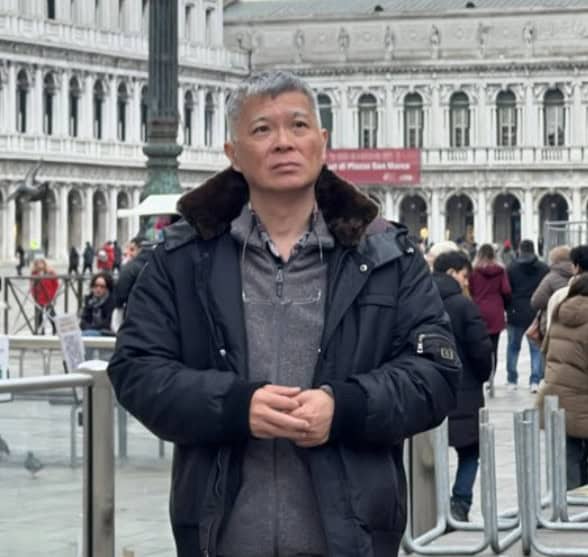
Michael Koh is a production specialist and entrepreneur who founded Spring Forest Studio in 2017 to provide event and virtual production solutions in Singapore. He specialises in hybrid live streaming, XR (Extended Reality) virtual production, and studio systems integration, transitioning the business from traditional videography to advanced corporate broadcasting. Operating out of a dedicated facility at NordCom2 in Singapore, he leads a technical crew to deliver multi-camera webcasts, digital sets, and technical consultations for large-scale corporate events.