
The Hybrid Press Conference as an Enterprise Communication Event
A hybrid press conference is no longer a simple combination of a room microphone and a webinar link. For corporate communications teams, public affairs units, investor relations departments, and multinational brands, it is a high-stakes live production that must serve two audiences at once, the journalists in the physical venue and the media representatives connecting remotely from other cities, time zones, and network conditions. The technical challenge is to preserve editorial access, audio intelligibility, camera continuity, and press-ready signal quality while maintaining security, redundancy, and consistent brand presentation across every distribution path.
In B2B event streaming, the hybrid press conference sits at the intersection of broadcast engineering, enterprise networking, and real-time communications. A successful implementation requires more than a meeting platform. It demands a controlled signal chain, deterministic routing, managed encoding, resilient uplink design, and a production workflow that can support live questions, multilingual interpretation, simultaneous recording, and downstream content repurposing. For organizations hosting product announcements, regulatory briefings, M&A disclosures, or crisis communications, the technical standard must be aligned with professional live event production rather than generic conferencing.
In Singapore and other global business hubs, hybrid press conferences often include local news desks, regional bureaus, and international correspondents who need reliable remote access with stable latency and clean program output. The production team must therefore design for mixed distribution, with one feed optimized for in-room projection, one program stream for remote media, and, when required, clean ISO feeds for post-event editing, archival compliance, and internal communications review.
Designing the Production Architecture for Local and International Media
Signal flow from source to program
The foundational design task is the signal path. A typical hybrid press conference begins with source devices such as broadcast cameras, presentation laptops, graphics systems, wireless microphones, and IFB, or interruptible foldback, feeds for talent and moderators. These sources are ingested into a production switcher, where the technical director controls program output, preview, transitions, keying, and downstream signal distribution. In a professional workflow, cameras may enter the system over SDI, or Serial Digital Interface, to preserve signal integrity over long runs, while contribution laptops can enter via HDMI 2.1 or through dedicated scan converters to ensure proper frame-rate and color-space matching.
For larger venues, the production core often includes a vision mixer, an audio console, a router, and a multiview system. The router centralizes source distribution to confidence monitors, recording devices, and encoding hardware. Multiview monitoring provides the production crew with visibility across camera sources, graphics playback, return feeds, tally status, and audio meters. In a press conference, this is essential for maintaining a clean editorial line and avoiding dead air, clipping, or sync drift.
Choosing between SDI, NDI, and hybrid transport
Modern press conference systems increasingly use IP workflows alongside traditional baseband infrastructure. SDI remains the most predictable transport for mission-critical camera and router paths because it is mature, deterministic, and widely supported in broadcast-grade production environments. Network Device Interface, or NDI, enables low-latency video transport over managed Ethernet networks, which is useful for auxiliary cameras, confidence feeds, and rapid deployment in temporary venues. NDI|HX can reduce bandwidth requirements by using more efficient compression, but it introduces trade-offs in quality and latency that must be evaluated carefully for press-facing content.
In enterprise hybrid production, a mixed architecture is common. SDI is used for primary cameras, graphics playout, and the main program bus, while NDI or NDI|HX may be used for overflow sources, remote-controlled PTZ cameras, or inter-room distribution. This hybrid approach balances quality, cabling complexity, and scalability. The critical requirement is disciplined clocking, format normalization, and monitoring, so that all sources conform to a single production standard, for example 1080p25, 1080p30, or 2160p30 depending on the venue, audience expectations, and downstream platform constraints.
Encoding, Transport, and Distribution for Press-Grade Delivery
Program stream design and codec selection
The distribution layer defines how the press conference reaches local and international media. For public internet delivery and enterprise platform integration, H.264 remains the most universally compatible codec, while H.265, also called HEVC, can deliver better compression efficiency at comparable visual quality, especially for 4K UHD workflows. The choice depends on decoding support in the destination environment and the expected bandwidth conditions. For most press operations, 1080p at 25 or 30 frames per second remains the operational baseline because it provides a strong balance between quality, latency, and compatibility. Bitrate management should be conservative enough to prevent macroblocking during motion-heavy moments such as camera cuts, speaker gestures, or slide transitions, yet efficient enough to preserve headroom across the upstream path.
For live contribution transport, Secure Reliable Transport, or SRT, is a preferred protocol when traversing unpredictable public networks because it uses encryption, packet recovery, and adaptive retransmission to maintain stream stability. RTMP, or Real-Time Messaging Protocol, and RTMPS remain relevant for legacy platform compatibility and certain media gateways. In practice, many enterprise productions use SRT for primary contribution from the venue to a cloud ingest point or remote production hub, then transcode or package outputs for multiple destinations. This is especially useful when sending a master feed to a media archive, a secure internal distribution portal, or a platform such as Microsoft Teams, Zoom, or Webex for invited remote participants.
Latency, synchronization, and confidence monitoring
Latency strategy depends on the use case. A press conference does not usually require ultra-low latency for audience participation, but it does require controlled conversational timing for live questions and moderator management. If remote journalists are expected to ask questions in real time, the production must minimize round-trip delay through protocol selection, encoder settings, and network optimization. SRT can be tuned for lower latency at the expense of resilience, while cloud-based production workflows often introduce additional processing delay. For this reason, remote questions are frequently handled through a moderated queue, with an operator unmuting each journalist in sequence and using talkback systems for production coordination.
Synchronization is also essential. Audio must remain locked to the program feed, with delay compensation applied when routing through external processors, encoders, or cloud interfaces. Timecode-aware ISO recording supports later editorial work, while clean program capture ensures that the delivered archive reflects exactly what the media received. Professional teams monitor audio-video sync continuously, typically with a reference display and audio meters on the production multiview. If the event includes live captioning or language interpretation, the caption encoder and interpreter output path must be integrated into the same timing model to avoid drift.
Audio, Camera, and Control Requirements for Media Engagement
Microphone strategy and speech intelligibility
In press conference production, audio quality often determines whether the event is considered media-ready. A hybrid setup usually combines podium microphones, boundary microphones for question areas, wireless lavaliers for moderators, and possibly handheld microphones for open Q and A sessions. The mixing engineer must maintain gain structure with enough headroom to absorb sudden speech peaks without distortion. Speech intelligibility is improved through appropriate equalization, feedback suppression, and room tuning. In conference spaces with challenging acoustics, acoustic treatment and directional microphone selection matter as much as the console settings.
For remote media participants, the audience must hear not only the speaker but also the questioner. That requires a clear return path from the question mic array into the program bus. When international journalists join remotely, the production may also need a separate mix-minus feed, so that each remote participant hears the program without echoing their own contribution back to them. This is standard practice in professional broadcast conferencing and should be implemented through the audio matrix or digital mixer rather than improvised through consumer conferencing settings.
Multi-camera coverage and editorial control
A strong hybrid press conference typically uses at least two cameras, with three or more preferred for dynamic coverage. A wide master shot establishes context, while a tighter camera frames the speaker podium, and a roaming or side camera captures audience interaction or panel discussion. PTZ, or pan-tilt-zoom, cameras are useful for compact spaces and remote operation, but they should be integrated with predictable presets and matching color profiles so the shot transitions remain visually consistent. For premium executive events, larger sensor studio cameras provide better depth, low-light performance, and more precise color rendition.
Switching should be driven by content logic, not by convenience. A camera cut on a question, a slide change, or a speaker movement gives the remote journalist a clear editorial signal. Graphics integration should include lower-thirds, speaker identifiers, translated titles when required, and time-stamped status slates for internal teams. In a multilingual press conference, live interpretation channels may be delivered through separate audio outputs or platform-specific interpretation features, depending on the chosen distribution environment.
Network Infrastructure, Redundancy, and Security
Bandwidth planning and managed connectivity
The network layer is where many hybrid events succeed or fail. A press conference that supports local and international media should never rely on a single consumer-grade internet line. Enterprise deployment should include a primary wired uplink, a diverse backup path, and quality of service, or QoS, policies that prioritize encoder traffic over nonessential data. For contribution streams, upstream bandwidth should be sized with adequate margin above the target bitrate, accounting for encoder overhead, retransmission buffers, and network variability. If the main program stream is 8 Mbps, the venue should not operate with an uplink provisioned at exactly 8 Mbps. Practical engineering requires sufficient headroom for stability and recovery.
Where possible, bonded connectivity or dual-WAN failover should be used. LTE, 5G, or a secondary fixed-line connection can provide continuity if the primary circuit degrades. The production team should test failover before event day, including path switching on the encoder, DNS behavior, and platform ingest recovery. Internal venue networking should be segmented, with production devices isolated from guest Wi-Fi and office traffic. VLANs, or Virtual Local Area Networks, help reduce broadcast congestion and improve security by separating control traffic, media transport, and administrative access.
Security, access control, and media integrity
Corporate press conferences frequently involve embargoed announcements, financial disclosures, or confidential executive statements. Security therefore extends beyond the venue doors. Stream URLs, encoder credentials, remote guest access, and platform permissions should be managed through strict access control lists and time-limited authentication. RTMPS or encrypted SRT should be used where supported. If remote journalists are joining via a conferencing platform, the waiting room, moderator controls, and participant permissions must be configured to prevent uninvited interruption. For high-sensitivity events, the production may also require a private distribution layer with authenticated playback and controlled recording policies.
Media integrity includes a clear distinction between the live program feed, the clean feed, and any interpreted or captioned variants. Each should be labeled and logged so downstream communications teams can archive the correct asset. ISO recording, where each camera and audio source is captured separately, gives editorial teams the flexibility to produce regional edits, highlight clips, or legal review copies after the event. This is standard practice in enterprise production because it preserves the original source material and simplifies post-event compliance workflows.
Cloud-Based Versus On-Premise Production Models
When to use cloud production
Cloud-based production is attractive when a press conference must reach dispersed media stakeholders across multiple regions or when a corporate communications team wants remote access to switching, graphics, and clipping tools. Cloud workflows can support distributed operators, centralized replay, and rapid scaling for multi-language events. They also reduce physical equipment requirements at the venue. However, cloud production introduces dependency on internet quality, remote routing, and service availability. For live press events with narrow timing windows, cloud systems should be tested under production-like conditions well before the event date.
Cloud ingest is often paired with local contribution encoding. The venue encodes a primary feed to a cloud endpoint using SRT or RTMP, and the cloud environment handles downstream distribution to the webcast platform, archive, and remote participants. This model works best when the venue has stable uplink capacity and the event does not require ultra-low latency interaction. The technical team should validate latency, audio sync, platform compatibility, and return video before launch.
When on-premise control is the better fit
On-premise production remains the preferred model when the event requires maximum reliability, precise editorial control, and minimal external dependencies. A local switcher, router, audio console, and encoder chain can be engineered for deterministic performance with protected power, redundant storage, and controlled cabling. This is especially valuable for executive announcements, regulatory briefings, and high-profile press events where timing and message discipline are critical. On-premise systems also simplify the operation of dedicated ISO recording, local confidence monitoring, and in-room AV integration.
Many enterprise deployments use a hybrid architecture, keeping critical switching and recording on site while leveraging cloud services for distribution, transcription, or archival access. This gives the client the resilience of local production with the scalability of network-based delivery. The correct balance depends on the number of remote participants, the complexity of multilingual workflows, and the security profile of the organization.
Implementation Guidelines for Enterprise Press Events
Pre-production engineering checklist
A technically robust hybrid press conference starts with a full engineering survey. The production team should confirm room acoustics, power availability, cable routes, rigging points, camera positions, sightlines, and network handoff details. Every major device should be labeled, tested, and documented. Frame rate, resolution, audio sample rate, and color space must be agreed in advance so that all vendors work from the same production standard. If multiple facilities are involved, the team should verify codec compatibility, platform ingest requirements, and remote participation workflows before load-in.
Monitoring and rehearsal are not optional. A complete run-through should include speaker walk-ons, question handling, slide playback, interpreter testing, network failover, and a full record-and-playback check. Production teams should verify that the returned remote feed is intelligible, that the camera cuts are clean, and that the moderator can manage both the in-room and virtual question queues without confusion. If the event is being held in Singapore for a regional announcement, the schedule must account for regional time zones so international media can join at practical hours without degrading production quality.
Operational best practices during the live event
During transmission, the technical director, audio engineer, streaming operator, and stage manager should work from a shared cue sheet and intercom protocol. Talkback systems keep camera operators, moderators, and control room staff synchronized. The audio operator should watch meters continuously and keep peak levels controlled to avoid distortion. The streaming operator should monitor bitrate, dropped frames, encoder health, and platform latency. The stage manager should coordinate the physical room and the remote moderator flow so that local journalists and international correspondents receive equal access to the briefing.
After the event, archive the program feed, ISO sources, graphics files, logs, and stream analytics. These materials support compliance, editorial review, and future production planning. A well-run hybrid press conference produces not just a live event, but a reusable asset library that can support internal communications, regional media follow-up, and executive reporting.
The hybrid press conference is a demanding format, but with the correct infrastructure, it delivers exceptional reach. Local journalists receive the immediacy of a live room experience, international media gain secure remote access, and enterprise stakeholders retain full control over quality, security, and brand presentation. For organizations that depend on accurate messaging and high production standards, the right approach is a broadcast-caliber hybrid workflow built on reliable transport, disciplined signal management, and engineered redundancy from end to end.
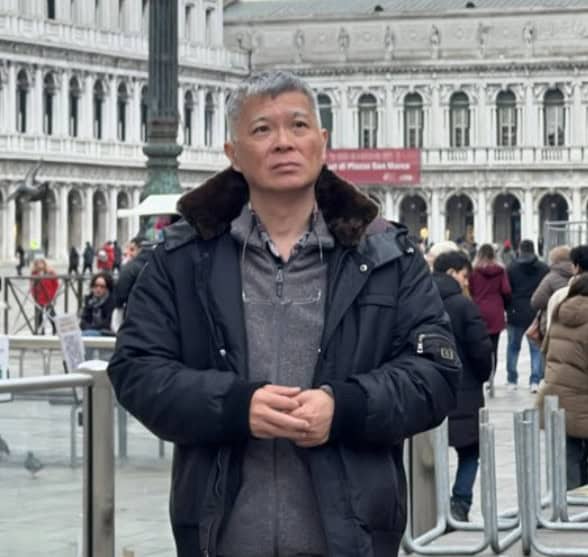
Michael Koh is a production specialist and entrepreneur who founded Spring Forest Studio in 2017 to provide event and virtual production solutions in Singapore. He specialises in hybrid live streaming, XR (Extended Reality) virtual production, and studio systems integration, transitioning the business from traditional videography to advanced corporate broadcasting. Operating out of a dedicated facility at NordCom2 in Singapore, he leads a technical crew to deliver multi-camera webcasts, digital sets, and technical consultations for large-scale corporate events.