
Why the Hybrid Production Booth Matters for Enterprise Events in Singapore
Singapore has become one of the most demanding environments for corporate event production in Asia, not because of scale alone, but because expectations are consistently high across venue quality, network reliability, multilingual audiences, and executive-level presentation standards. For enterprise clients, the hybrid production booth is the operational center where the physical event and the virtual event are fused into one controlled delivery system. It is not simply a backstage control table. It is a live engineering environment that coordinates camera acquisition, audio routing, graphics insertion, encoding, platform integration, and monitoring for both in-room delegates and remote participants.
In a hybrid corporate event, the production booth must support low-latency communication between crew roles, maintain clean program output for the venue, and generate separate feeds for streaming platforms or conferencing environments such as Microsoft Teams, Zoom, and Webex. In Singapore, where many events are hosted in hotels, convention centers, integrated resorts, and purpose-built corporate venues, the booth also has to adapt quickly to different room acoustics, fiber availability, venue power layouts, and network restrictions. That is why experienced production teams design the booth as a system, not as a collection of devices. The workflow usually combines SDI, HDMI 2.1, NDI, SRT, RTMP, intercom, and redundant network paths into a coordinated broadcast-style control room.
Inside the Hybrid Production Booth Architecture
Camera ingest, switching, and program creation
A typical enterprise hybrid production booth begins with multi-camera ingest. Depending on the venue and creative requirements, operators may deploy PTZ cameras, box cameras, or cinema-style cameras with clean HDMI or SDI outputs. In professional event environments, SDI remains the preferred transport layer for longer cable runs and deterministic signal stability, particularly for 1080p59.94, 1080p50, or 2160p workflows. HDMI 2.1 can be used for short runs and specific source devices, but it is rarely the backbone of a corporate control room because the cable length and handshake behavior are less predictable than SDI.
The vision mixer, also called the video switcher, is the core of the booth. It receives camera feeds, presentation laptops, remote guest sources, and media playback signals. The switcher may output a single program feed, auxiliary feeds for in-room screens, and separate clean feeds for encoding or recording. Many enterprise events require ISO recording, which means isolated recordings of each camera and source in addition to the live program. ISO recording is valuable for post-event editing, compliance review, training content, and executive communications.
In a Singapore board meeting, product launch, or regional town hall, production teams often use multiview monitoring to supervise all active sources. A multiview display shows camera status, audio meters, graphics preview, network return, and program output on one screen. This gives technical directors a fast way to confirm that a remote speaker is framed correctly, a presentation source is active, and all transitions are safe before they are taken live.
Audio engineering and talkback coordination
Audio is one of the most critical elements in hybrid production because remote audiences tolerate low-resolution video more easily than poor speech intelligibility. The booth usually includes a digital mixing console, stage boxes, wireless microphone receivers, line inputs from podiums, and return audio from remote contributors. Professional event audio workflows should be built around gain structure discipline, proper equalization, acoustic management, and clear routing between program, foldback, and conferencing mixes.
For hybrid events, the audio engineer often creates at least three separate mixes. The in-room mix serves loudspeakers or distributed audio systems. The program mix is the balanced output embedded into the live stream. The communication mix, or mix-minus, removes the remote caller’s own voice from their return feed to avoid echo and feedback loops. This is especially important when integrating with Teams, Zoom, or Webex, where improper return routing can create unusable audio artifacts. Talkback systems are also essential. Production crew need low-latency intercom channels between the director, camera operators, graphics operator, audio engineer, and streaming engineer. In larger Singapore events, intercom matrices or digital partyline systems are used to maintain coordination across stage, control room, and venue support teams.
Signal Flow, Encoding, and Delivery Standards
From camera sensor to encoded stream
The signal path in a hybrid booth is designed to protect image quality while meeting latency and resilience targets. A camera source typically travels over SDI or NDI to the switcher, then to an encoder, then to either a managed streaming platform or a conferencing bridge. In IP-based production environments, NDI, including NDI|HX for bandwidth-efficient acquisition, enables flexible source sharing over a local network. However, NDI implementation must be paired with a properly engineered switch fabric, low congestion, and strict VLAN segmentation if it is to remain reliable in high-pressure event conditions.
Encoding is where the physical production feed becomes an internet deliverable. H.264 remains the most common codec for live enterprise streaming because of its broad compatibility and efficient balance of quality and compute cost. H.265, also known as HEVC, can deliver better compression efficiency at comparable quality, but client compatibility and platform support must be verified in advance. Bitrate management is central to quality. A 1080p stream for corporate delivery often ranges from roughly 4 to 8 Mbps depending on motion, graphics density, frame rate, and platform requirements. For 2160p UHD delivery, substantially higher bitrates are required, and network headroom becomes more important. The engineering team must also decide between constant bitrate, variable bitrate, and constrained variable bitrate behaviors based on the target platform and the need for predictable delivery.
Latency targets depend on the use case. A webcast for passive viewing can tolerate higher end-to-end latency, while a live Q and A session requires tighter synchronization between in-room and remote participants. SRT, or Secure Reliable Transport, is widely used for contribution links because it handles packet loss more gracefully than simple UDP transport while maintaining lower latency than many fully managed cloud paths. RTMP and RTMPS remain relevant for platform delivery and compatibility, especially where enterprise workflows are still anchored to established ingest endpoints. For mission-critical corporate events, many teams use SRT for contribution from the venue to a cloud processing point, then distribute to final platforms from there.
Standards awareness in a production workflow
Professional booths operate with a standards-based mindset. SMPTE practices influence video timing, signal transport, and format interoperability. Audio workflows often reference AES practices for digital audio transport and calibration. ISO-based operational procedures also matter, particularly for documentation, asset naming, quality control, and structured production handover. In practical terms, this means documenting frame rate, resolution, aspect ratio, audio sample rate, network VLAN assignment, encoder preset, and failover path before doors open. A booth that follows disciplined standards can be transferred between different Singapore venues with less risk and shorter setup windows.
Network Infrastructure for Hybrid Production in Singapore
Bandwidth, segmentation, and resilience
Hybrid production is now a network engineering problem as much as a video problem. A venue in Singapore may have excellent broadband on paper, yet still require careful planning for multicast, firewall policy, upstream shaping, and WAN stability. Production teams should isolate production traffic from guest Wi-Fi and general office networks. A dedicated production network with managed switches, redundant uplinks, and QoS, or Quality of Service, policy is standard practice for serious corporate events. QoS prioritization ensures that time-sensitive traffic such as intercom, tally, NDI, and remote contribution streams receive priority over non-critical traffic.
Where possible, bonded internet connections or dual independent ISP paths should be used for critical events. Redundancy is not just about a backup encoder. It includes upstream internet diversity, backup power, spare network switching, mirrored graphics systems, and alternate delivery destinations. If the event is streamed to a managed platform, the encoding path should be able to fail over to a secondary ingest endpoint with minimal interruption. Some teams also maintain a parallel local recording path so that even if the outbound stream is disrupted, the content is preserved in full quality for immediate recovery or later distribution.
Singapore venues often support strong connectivity, but production engineers still validate actual throughput with real-world tests rather than relying on nominal bandwidth figures. They should confirm upload stability, packet loss, jitter, and path consistency under load. For SRT contribution, the team should test latency settings, sender and receiver buffer behavior, and firewall traversal before live day. For RTMP, they should confirm ingest availability, stream key validity, and encoder reconnect behavior. For NDI workflows, they should verify that the local network can sustain the aggregate bitrate of all active sources with sufficient margin for control traffic and monitoring.
Cloud-based versus on-premise control
Cloud processing can simplify remote participation, graphics scaling, and multi-destination streaming, but it does not remove the need for a robust physical booth. On-premise switching and mixing still provide the lowest operational risk for in-room execution, particularly when the event includes live speakers, stage content, and sponsor playback. A common enterprise model is a hybrid architecture with on-site acquisition and switching, plus cloud-based contribution, transcoding, or distribution. This approach preserves local control while using cloud infrastructure for scalability and remote access.
On-premise systems are often preferred for highly controlled events such as investor briefings, government-adjacent sessions, product launches with strict embargoes, and internal leadership meetings. Cloud solutions can be efficient for decentralized global town halls, distributed training, and events requiring many remote presenters. The correct choice depends on security requirements, latency tolerance, IT governance, and operational complexity. The most reliable deployments often combine both, with local production as the primary path and cloud services as the distribution and resiliency layer.
Operational Best Practices for Enterprise Hybrid Events
Pre-production engineering and room design
Before a booth is assembled in Singapore, the production team should complete a technical site survey. This includes checking stage dimensions, audience sightlines, camera positions, cable routes, rack space, power distribution, ambient noise, RF environment, and internet handoff location. Power should be split across appropriate circuits to avoid tripping a single distribution line. Critical systems such as switchers, encoders, routers, and network switches should be supported by uninterruptible power supplies, with generator compatibility if the venue provides backup power.
Room acoustics should also be reviewed early. Hard surfaces, glass walls, and high ceilings can produce reverberation that affects speech clarity. The audio system must be tuned to the room rather than assumed from a prior event. Microphone selection should follow the speaking format. Lavaliers suit mobility and panel discussions, handheld microphones are useful for moderated Q and A, and gooseneck podium microphones are appropriate for formal corporate addresses. Each source should be checked for gain before the show, and a full line check should be completed with all presenters if possible.
Live show execution and quality control
During the live event, the booth runs on checklists and role discipline. The director manages show flow, the technical director handles switching, the audio engineer balances speech and playback, the graphics operator controls titles and lower thirds, and the streaming engineer monitors encoder health, stream status, and CDN or platform responses. A well-run booth has visible confidence indicators, such as signal meters, return confidence monitors, recording timers, and network telemetry.
Quality control should never depend on a single viewer’s observation. Engineers monitor the stream from multiple points, including program output, platform preview, and a separate external device on a different network path. For hybrid Q and A, moderation tools need to be tested in advance so remote questions appear in the correct workflow without disrupting the program feed. If the event includes multilingual interpretation, separate audio channels and clear labeling are required. In enterprise settings, a failure to manage audio language routing can create confusion immediately and reduce audience trust.
Post-event recovery, archiving, and compliance
After the event, the booth’s role continues with file verification, archive management, and post-mortem analysis. ISO recordings should be checked for integrity, file naming should align with internal asset management rules, and logs from switchers, encoders, and network devices should be preserved for troubleshooting and future optimization. Corporate clients often require secure retention of event assets for training, legal reference, or internal communications. A clean archive package includes the master program file, isolated camera feeds if applicable, graphics assets, and a technical summary covering codecs, bitrates, frame rates, and routing topology.
What Enterprise Clients Should Specify When Hiring a Hybrid Production Team
Technical requirements that reduce risk
Enterprise planners and AV managers should request a written technical design that identifies the complete signal chain, redundancy model, and platform delivery method. The scope should specify camera count, switcher model class, audio console workflow, encoder architecture, backup internet strategy, recording format, and integration points with Teams, Zoom, Webex, or a managed webcast platform. If the event is in Singapore, the team should also confirm venue compliance procedures, loading access timing, and any restrictions on network provisioning or RF deployment.
Clients should also insist on pre-event testing. A rehearsal is not enough if it does not include full signal flow, presenter onboarding, platform login, and failover simulation. For example, if the main internet path is interrupted, the crew should know exactly how long the backup path takes to activate, whether the stream reconnects automatically, and what changes in latency or quality to expect. That level of planning is what separates an ordinary production setup from an enterprise-grade hybrid booth.
The hybrid production booth is where technical discipline becomes audience trust. In Singapore, where the corporate event market demands precision, the best booth design combines broadcast engineering, IP networking, audio integrity, and platform interoperability into one reliable operating model. When that model is executed correctly, the physical room and the virtual audience feel like a single event, not two disconnected experiences. That outcome depends on standards-based infrastructure, rigorous pre-production, and operators who understand that live streaming for enterprise is a systems engineering task first and a creative task second.
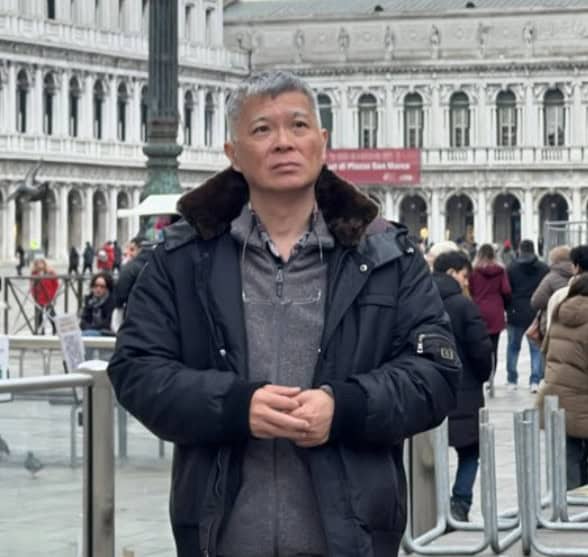
Michael Koh is a production specialist and entrepreneur who founded Spring Forest Studio in 2017 to provide event and virtual production solutions in Singapore. He specialises in hybrid live streaming, XR (Extended Reality) virtual production, and studio systems integration, transitioning the business from traditional videography to advanced corporate broadcasting. Operating out of a dedicated facility at NordCom2 in Singapore, he leads a technical crew to deliver multi-camera webcasts, digital sets, and technical consultations for large-scale corporate events.