Reframing Faith Community as a High-Reliability Hybrid Communication Environment
Faith communities now operate in a communications model that resembles a distributed enterprise event environment, where in-person congregants, remote participants, ministry staff, volunteers, and technical operators all depend on consistent, low-latency, intelligible live delivery. The virtual sanctuary is not a casual webcast. It is a mission-critical production ecosystem that must support sermons, liturgy, prayer meetings, pastoral counseling sessions, youth programs, funerals, weddings, multilingual services, and large-scale seasonal observances with the same discipline used in corporate hybrid events and executive town halls. For production teams, the challenge is not simply transmitting video. It is preserving participation, clarity, emotional resonance, and operational continuity across physical and digital congregation spaces.
From a technical perspective, the virtual sanctuary combines live event production, streaming architecture, audio engineering, network resilience, and user experience design. In practical terms, that means building a workflow that can capture clean speech, music, ambient congregation sound, and visual context, then distribute that program to platforms such as Microsoft Teams, Zoom, Webex, and custom enterprise portals without compromising synchronization, reliability, or content quality. The same considerations that govern enterprise B2B event streaming, including redundancy, signal integrity, encoding efficiency, and monitoring, apply directly to faith-based productions. The difference is that the content has a relational and pastoral dimension, so failure modes are more visible and more disruptive. A dropped stream, clipped vocal, or poorly mixed room feed can break connection at the exact moment the audience is seeking reassurance and community.
For Singapore-based organizations and regional ministries serving multilingual audiences, the technical bar is even higher. Dense urban RF environments, varied venue acoustics, multiple language overlays, and mixed onsite and remote attendance patterns create a production environment that benefits from enterprise-grade planning. The objective is to create a robust, repeatable, and scalable production architecture that can serve a weekly service, a special holiday broadcast, or a citywide faith event with equal consistency.
Designing the Hybrid Worship Production Workflow
Signal acquisition and front-end capture
The foundation of any virtual sanctuary is high-quality source capture. A typical hybrid worship workflow begins with multiple video acquisition points, including a primary wide shot of the stage or altar, close framing for the speaker, supplemental camera angles for musicians or choir sections, and audience coverage for responsive moments such as prayer, testimony, and congregational singing. For professional results, most operators deploy a multi-camera system using SDI, Serial Digital Interface, for long cable runs and predictable signal transport. In smaller spaces or temporary setups, HDMI 2.1 may be used for short-distance camera or presentation feeds, but SDI remains the preferred backbone for larger venues because of its locking connectors, signal robustness, and compatibility with broadcast-style switching infrastructure.
Where IP video is required, NDI, Network Device Interface, and NDI|HX can be used to move camera and computer sources across a managed network. NDI is especially useful in modular production environments, such as multi-room campuses or temporary control rooms, because it reduces the dependency on direct baseband cabling. However, NDI introduces network design requirements that must be managed carefully, including multicast planning, switch capacity, VLAN segmentation, and adequate backbone throughput. For enterprise reliability, many production teams use NDI for flexible routing internally and SDI for mission-critical camera paths, then convert to the streaming encoder at the final aggregation point.
Audio engineering as the primary quality determinant
In faith productions, audio quality drives perceived professionalism more than video resolution. Speech intelligibility, vocal warmth, music balance, and room ambience all influence audience retention and engagement. A well-designed hybrid service uses dedicated microphones for clergy, pastors, readers, and musicians, then routes those signals into a digital audio console capable of scene recall, dynamics processing, routing matrices, and direct multitrack or stereo program output. In most cases, the program feed should not mirror the house reinforcement mix exactly. The room mix is optimized for loudspeakers in the venue, while the stream mix is optimized for headphones, laptops, smart speakers, and mobile devices. These two environments require different equalization, compression, and reverb treatment.
Professional audio workflows often include a dedicated streaming mix bus, separate from the front-of-house mix, with controlled low-frequency content, moderate dynamic range compression, and careful control of congregation bleed. Talkback systems are also valuable in larger productions because they permit communication between camera operators, audio engineers, video directors, and stage managers. When the service includes remote presenters or worship leaders, audio hybridization tools and echo cancellation become essential. Any remote contribution should be tested for latency, return audio configuration, and echo suppression before the live window opens.
Streaming Protocols, Encoding Standards, and Delivery Architecture
RTMP, RTMPS, and SRT in worship delivery chains
The outgoing stream from a virtual sanctuary typically uses one of three transport strategies. RTMP, Real-Time Messaging Protocol, remains widely supported by destination platforms and is still common for first-mile contribution and platform ingestion. RTMPS adds TLS encryption to RTMP transport, which is preferable for environments with stronger security requirements. SRT, Secure Reliable Transport, is increasingly used for contribution and point-to-point transport because it provides packet loss recovery, encryption, and adaptive latency handling over unmanaged networks. For mission-critical hybrid services, SRT is particularly valuable when transporting feeds between campuses, remote production sites, or bonded internet endpoints.
In a practical deployment, the venue may send a primary program feed via SRT to a remote production hub, where it is switched, monitored, recorded, and encoded for distribution to multiple platforms. This approach separates venue operations from content delivery and allows a technical team to centralize expertise. For smaller single-site worship environments, a local encoder may publish directly via RTMPS to the destination platform, with a parallel ISO recording and backup recording path for post-event archiving.
Codec selection, resolution, and bitrate management
For modern faith community streaming, H.264 remains the most broadly compatible encoder codec, especially when the audience includes older devices, managed enterprise desktops, and mixed mobile environments. H.265, also known as HEVC, offers superior compression efficiency but may not be universally supported across all distribution endpoints or hardware decoders. For that reason, H.264 is often the default for live worship distribution, with H.265 reserved for internal archive workflows or controlled ecosystems.
Resolution and frame rate should match the production goal. A 1080p feed at 30 frames per second is common and remains a strong balance between quality and bandwidth efficiency. When visual motion is significant, such as in music-led services or liturgical processions, 1080p60 can improve motion rendering if bandwidth and compute budgets allow. For large sanctuaries or high-end productions, 4K, also referred to as UHD, may be captured for archival or future repurposing, but live delivery at 4K should be weighed against the actual audience device mix, delivery platform limitations, and upstream network capacity.
Bitrate management is a critical control point. A clean 1080p stream often falls within a practical range of 4 to 8 Mbps for H.264, depending on motion complexity, encoder quality, and the target platform. Audio is commonly delivered at 128 to 192 kbps AAC for speech and mixed worship content, with higher settings appropriate for music-rich productions. Operators should align encoder keyframe interval, profile, and rate control settings with platform requirements to avoid buffer instability or transient quality loss. Variable bitrate encoding can be effective, but the encoder must be tuned conservatively enough to preserve consistency during dense choir passages, screen graphics, or camera moves.
Production Control, Switching, and Monitoring Infrastructure
Multi-camera switching and program assembly
A professional virtual sanctuary benefits from a vision switcher that supports clean transitions, downstream keying, picture-in-picture, media playback, and multiview monitoring. The switcher is the editorial center of the live service. It should ingest camera feeds, slides, lyrics, pre-produced bumpers, scripture graphics, and remote guest inputs while maintaining program timing and visual coherence. In larger facilities, the production team may use a hardware switcher connected to an audio console, graphics workstation, and playback computer through synchronized transport paths. For distributed setups, a software-based production environment can be viable, provided the host system has sufficient CPU, GPU, storage, and network bandwidth, and the operator has disciplined source management.
ISO recording, meaning isolated source recording, adds significant post-event value. By recording each camera, the program output, and key audio stems separately, the team can recover from live errors, create edited clips for ministry communications, and produce archives for training or compliance. In a faith context, archival usefulness includes sermon indexing, testimony highlights, language translation review, and accessible replays for homebound congregants.
Multiview, confidence monitoring, and quality control
Monitoring is a non-negotiable component of any professional hybrid service. A multiview system should display camera status, audio meters, stream health, return video, graphics timing, and confidence audio. The engineering team should monitor program return from the destination platform, not only local outputs, to verify real-world delivery conditions. At minimum, this includes checking video sync, lip sync, audio peak management, dropped frames, bitrate stability, and encoder CPU or GPU load. If the venue serves a multilingual congregation, independent confidence monitoring for each language feed is necessary to verify correct routing and cue timing.
For audio monitoring, a calibrated reference chain and consistent listening environment are essential. Engineers should monitor on nearfield speakers and headphones, not only through the house PA. This helps detect excessive low-frequency buildup, sibilance, phase issues, and room reverb leakage that can degrade the remote worship experience. Loudness management should be stable across services, special events, and recorded segments so viewers are not forced to adjust volume repeatedly.
Network, Redundancy, and Enterprise Reliability Strategy
Bandwidth planning and QoS architecture
The network is the transport layer of the virtual sanctuary. A reliable hybrid workflow requires more than raw internet speed. It requires Quality of Service, QoS, configuration, traffic shaping, and capacity headroom. For a single 1080p stream, upstream bandwidth should exceed the encoded bitrate by a comfortable margin to accommodate overhead and transient spikes. If the service includes backup streams, cloud contributions, remote guests, or multichannel telemetry, the required aggregate bandwidth increases quickly. Production networks should be isolated from general office or guest Wi-Fi traffic through VLANs, dedicated switches, and where possible, separate internet circuits.
Where NDI or other IP video transport is used, switch fabric design becomes critical. Managed switches should support appropriate throughput, low latency, IGMP snooping where multicast is present, and sufficient non-blocking capacity for all active sources. In enterprise environments, a layered topology with edge, distribution, and core switching is preferable, especially in larger campuses or venues with multiple rooms. Network design should also account for DHCP, DNS, NTP time synchronization, and secure remote access for support personnel.
Redundancy, failover, and continuity planning
Redundancy is not optional for high-visibility worship events. At a minimum, critical systems should have backup power through uninterruptible power supplies, UPS, redundant audio capture paths, secondary encoder options, and alternate network connectivity. For higher-risk services, dual internet providers and dual encoding paths offer meaningful resilience. A common enterprise pattern is a primary encoder publishing through a primary circuit, with a secondary encoder or bonded backup link ready to fail over to the same destination or a mirrored destination endpoint.
Failover planning must also include content-level continuity. If the speaker microphone fails, a standby input or spare wireless channel should be immediately available. If the main camera loses signal, a safe wide shot or alternate angle should be ready on the switcher. If a remote guest link becomes unstable, the director should have a lower-third graphic, prerecorded testimony clip, or ambient service coverage available to bridge the interruption without creating dead air. These contingency designs are standard in mature corporate productions and should be equally standard in faith-based hybrid events.
Integration with Collaboration Platforms and Church Operations
Teams, Zoom, Webex, and managed participation workflows
Many faith communities now use enterprise conferencing platforms alongside traditional streaming destinations. Microsoft Teams, Zoom, and Webex are useful for prayer groups, leadership meetings, hybrid Bible studies, and remote participation in smaller ceremonial events. For larger worship services, these platforms can serve as interaction channels for prayer requests, backstage coordination, and guest speaker contribution, while the main program continues through a dedicated streaming stack. The key is to define platform roles clearly. A conferencing system is not a substitute for a broadcast-grade delivery chain, but it can complement one effectively when integrated with a proper contribution and return workflow.
Operationally, this requires a disciplined routing plan. One output may feed the live congregation screens, another may feed the in-room PA, a third may feed the streaming encoder, and another may return program reference to remote participants or presenters. Clear labeling, source naming conventions, and cue sheets reduce operator error and make the system sustainable for volunteer teams. In many churches, the technical team changes regularly, so documentation is as important as hardware.
Accessibility, archive, and multilingual delivery
A virtual sanctuary should also account for accessibility and inclusion. Closed captioning, translated overlays, and structured archive indexing improve reach and usability. Captions can be generated through live stenography, AI-assisted transcription with human review, or platform tools, depending on accuracy requirements and language complexity. For multilingual congregations, separate audio tracks or simultaneous interpretation feeds may be appropriate, especially in larger urban centers such as Singapore, where language diversity is a practical operational factor.
Archived services should be stored with clear metadata, date stamps, ministry category tags, and speaker identifiers. When organized correctly, the archive becomes a content management asset for pastoral follow-up, training, and community outreach. This is a core advantage of building the virtual sanctuary as an enterprise content system rather than a one-off stream.
Implementation Guidance for Enterprise-Grade Faith Streaming
The most effective virtual sanctuary strategy starts with a full system assessment. Map the venue acoustics, camera positions, stage layout, audience behavior, network topology, and staffing model. Determine whether the primary production should be local, remote, or hybrid. Then define technical standards for resolution, audio format, routing, recording, and delivery. For most organizations, the best results come from combining a disciplined baseband or IP video transport layer, a dedicated streaming encoder, separate house and stream audio mixes, and a monitored failover plan.
For church campuses and faith organizations with multiple rooms or sites, centralized production can improve consistency. A centralized control room can manage graphics, stream switching, archive management, and platform publishing while local technicians handle on-site capture and stage coordination. This model scales well when services are frequent, when multiple ministries need simultaneous production, or when volunteer turnover is a concern.
Finally, the virtual sanctuary should be treated as a living communication environment. Test every service path before the audience arrives. Verify encoder settings, audio routing, camera presets, remote guest links, caption workflows, and backup power. Maintain spare cables, spare microphones, spare network patch leads, and a documented incident response procedure. These practices turn a fragile stream into a dependable ministry platform.
When engineered correctly, the virtual sanctuary extends faith community connection beyond the walls of the building. It supports attendance, participation, pastoral care, and continuity with the same reliability expected from any enterprise-grade live event system. The result is not merely a digital broadcast, but a resilient hybrid production ecosystem that preserves community presence across physical and virtual space.
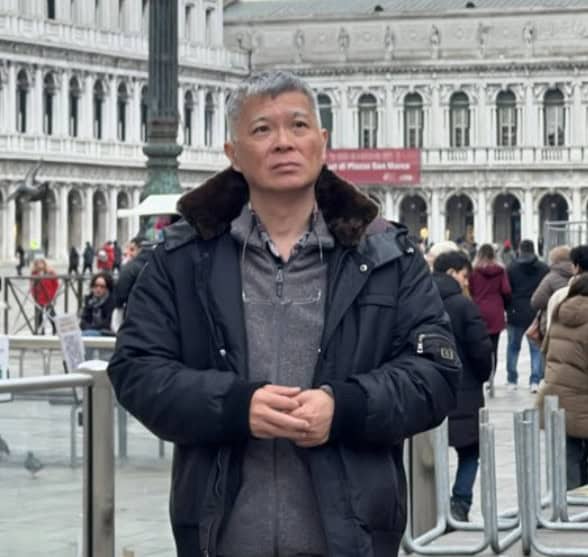
Michael Koh is a production specialist and entrepreneur who founded Spring Forest Studio in 2017 to provide event and virtual production solutions in Singapore. He specialises in hybrid live streaming, XR (Extended Reality) virtual production, and studio systems integration, transitioning the business from traditional videography to advanced corporate broadcasting. Operating out of a dedicated facility at NordCom2 in Singapore, he leads a technical crew to deliver multi-camera webcasts, digital sets, and technical consultations for large-scale corporate events.